Alphabet's Cash Burn Sparks Selloff as Microsoft Grinds Higher
The Spend Is the Story
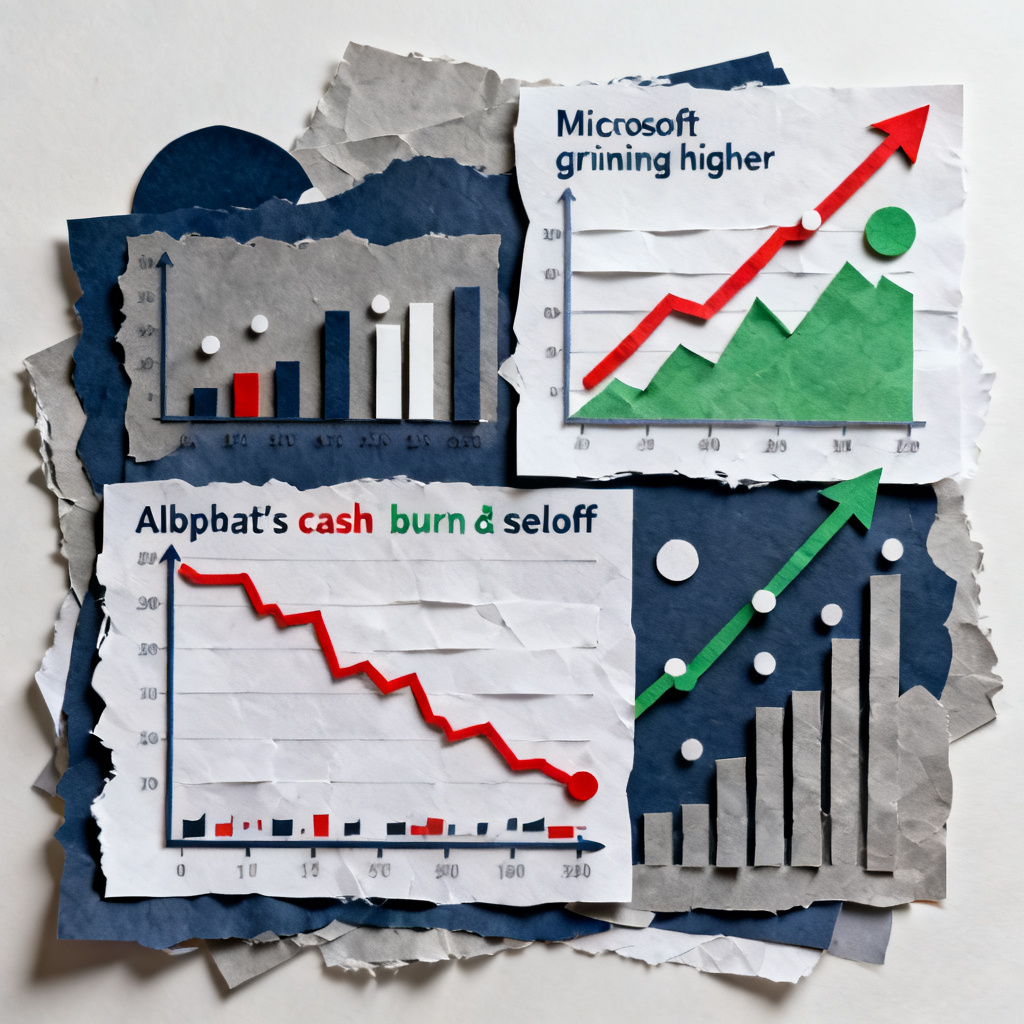
In the high-stakes arena of big tech earnings, the headline numbers—revenue and EPS—often take a backseat to subtler, more telling metrics. This quarter, the market’s verdict was delivered with brutal clarity through one simple figure: negative $9.07 billion. That’s Alphabet’s free cash flow for Q3, and it wasn’t just a miss. It was a shock, sending GOOGL tumbling over 10% premarket while rival MSFT climbed nearly 4%.
The implication for traders? This is no longer a generic “AI spending” story. It’s a story of discipline versus doubt, execution versus uncertainty.
A Tale of Two Balance Sheets
Let’s cut through the noise. Microsoft posted a hefty $45.2 billion in capital expenditures. That’s a 30% year-over-year jump, yet it was below the street’s sky-high expectations. More importantly, free cash flow, while down 27% to $18.63 billion, remained robustly positive. The narrative from Redmond is one of controlled, predictable investment. “Microsoft is building out its architecture in a measured way and as such contains fewer surprises,” noted one analyst.
Contrast that with Alphabet. Negative free cash flow of nearly $10 billion shattered expectations for a $2.70 billion shortfall. While the company maintained its full-year capex guide of $195-205 billion, the market is screaming a question: For what return? The cash burn, paired with a “messy” earnings call, suggests a strategy lacking the market’s confidence.
Search’s AI Dilemma Hits Home
The cash flow crisis is symptomatic of a deeper, more fundamental problem: pressure on Alphabet’s golden goose. Search advertising revenue grew 12% to $63.35 billion, but it still missed estimates. Why? The company admitted lower monetization within its experimental AI Mode. Translation: They’re wrestling with how to graft a profitable ad model onto next-gen AI search without breaking the money-making machine.
This is the innovator’s dilemma in real-time. While chatbots like ChatGPT and Claude siphon off exploratory queries, Google’s own Gemini has failed to capture the market’s imagination. “Google has lost its edge with Gemini and is behind peers on agentic AI,” the same analyst observed. The core business is under threat, and the path forward looks expensive and unclear. For investors, that’s a dangerous combination.
What This Means for the Broader Market
The immediate reaction was written in red across the Nasdaq. Futures were down over 1% early Thursday, dragged lower by Alphabet’s weight. The message to the entire tech sector is stark: blank-check spending on AI is no longer tolerated. The market wants a visible path to return on investment, and it’s punishing those who can’t provide it.
Microsoft’s relative strength offers a blueprint: spend aggressively, but do so within a framework the Street can model and trust. Alphabet’s plunge is a warning shot across the bow of any company betting the farm on an AI future with only promises to show for it. As we move past the initial land-grab phase of AI, financial discipline is becoming the new differentiator. The era of “growth at all costs” is giving way to a more mercenary calculation: what are you getting for your money?
The divergence between these two giants sets a new tone. It’s a signal that in the coming quarters, cash flow statements and capital efficiency will be scrutinized just as intensely as top-line growth. For traders, the playbook is shifting from pure momentum to a more nuanced mix of momentum and fundamentals. The companies that can articulate—and demonstrate—the ROI on their AI billions will be rewarded. The others risk becoming cautionary tales in a rapidly maturing market.