Credit Put Spreads: Master Long-Term Entries with the 200-Day MA
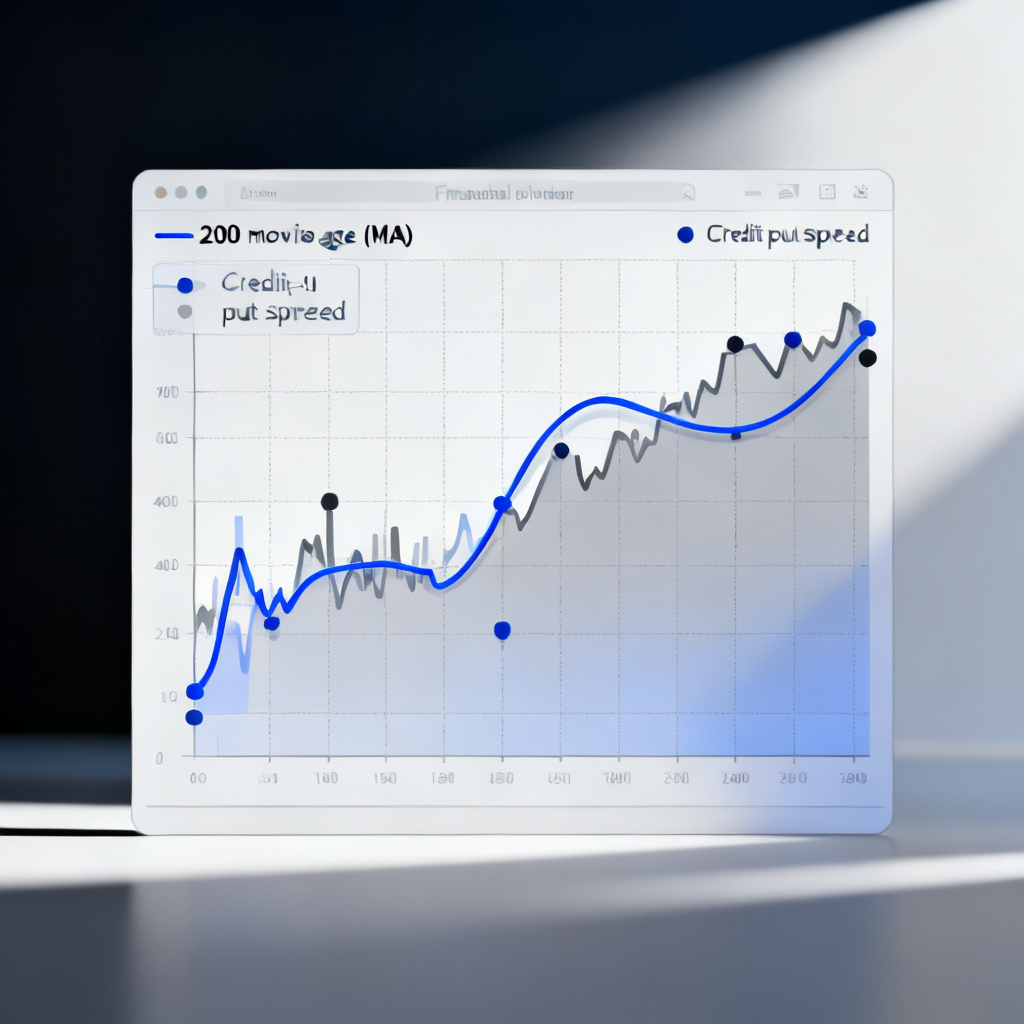
Credit Put Spreads: Using the 200-Day MA for Strategic Long-Term Entries
In the dynamic world of options trading, credit put spreads stand out as a powerful strategy for generating income and acquiring stock at a discount. While many traders focus on timing the market with short-term technical indicators, a longer-term perspective can significantly improve your probability of success. This post explores how integrating the 200-day simple moving average (200-day MA) can provide a robust framework for selecting strategic, high-probability entries for your credit put spread trades.
The Foundation: Mechanics of a Credit Put Spread
Before diving into the strategic entry, let's briefly review the mechanics. A credit put spread, also known as a bull put spread, is a defined-risk options strategy. You simultaneously sell one out-of-the-money (OTM) put option and buy one further OTM put option at a lower strike price. Both options share the same underlying asset and expiration date.
The goal is for the stock price to remain above the short put's strike price at expiration. If it does, both options expire worthless, and you keep the net premium received as profit. Your maximum risk is limited to the difference between the strike prices, minus the premium received. This structure makes it an excellent tool for traders with a neutral-to-bullish outlook on a stock.
Why the 200-Day Moving Average Matters
The 200-day simple moving average is one of the most widely followed long-term trend indicators. It smooths out price volatility and provides a clear visual of the primary market trend. For credit put spread traders, this indicator is invaluable for two key reasons:
- Trend Identification: A stock trading above its rising 200-day MA is generally in a long-term uptrend. Selling put spreads in an uptrend aligns your trade with the prevailing market momentum.
- Dynamic Support: The 200-day MA often acts as a major support level. During healthy uptrends, pullbacks to or near this average can present optimal entry points for bullish strategies like credit put spreads.
By waiting for a stock to demonstrate strength relative to its 200-day MA, you filter out trades in weak or chaotic markets, focusing your capital on higher-probability setups.
A Strategic Entry Framework Using the 200-Day MA
Here is a practical, step-by-step framework for entering credit put spreads using the 200-day MA.
Step 1: Identify the Trend and Quality
First, scan for stocks that are trading above a flat or rising 200-day MA. Avoid stocks that are far extended above the average, as they may be due for a sharper pullback. Instead, look for candidates that have recently pulled back towards the MA, showing signs of stabilization. The ideal scenario is a stock "kissing" the 200-day MA and then bouncing, confirming the level as support.
Step 2: Select Your Strikes Strategically
This is where the 200-day MA informs your strike selection. Once you have a confirmed bullish candidate, analyze the distance between the current price and the moving average.
- Short Strike Selection: Consider selling a put option with a strike price at or below the 200-day MA. For example, if a stock is trading at $105 and its 200-day MA is at $100, you might sell the $100 or $97.50 put. This placement gives the stock a "cushion" of support, as it has already shown a willingness to hold the MA level.
- Long Strike Selection: Buy a further OTM put (e.g., the $95 strike) to define your risk. The width of the spread (e.g., $2.50 or $5) determines your maximum potential loss.
Step 3: Manage Expiration and Premium
For this long-term trend-based approach, consider using expirations 45-60 days out. This provides enough time for your thesis (that support will hold) to play out while still allowing for decent time decay (theta). Aim for a credit that represents 25-35% of the spread's width. For a $5-wide spread ($100/$95), target a net credit of $1.25 to $1.75.
Practical Example: XYZ Corporation
Let’s walk through a real-world scenario. Assume XYZ stock is trading at $152. Its 200-day MA is steadily rising and currently sits at $145. The stock recently dipped to $147, touched the MA, and has now rebounded to $152.
Your Trade:
- You are bullish that the 200-day MA will continue to act as support.
- Sell 1 XYZ
$145 Put(at the MA level) expiring in 50 days for $3.00. - Buy 1 XYZ
$140 Putexpiring in 50 days for $1.20. - Net Credit: $1.80 ($3.00 - $1.20).
- Max Profit: $180 per spread (the credit received).
- Max Risk: $320 per spread (($5 spread width - $1.80 credit) x 100).
- Breakeven: $143.20 ($145 short strike - $1.80 credit).
This trade profits if XYZ closes above $145 at expiration. Your short strike is placed directly at the key 200-day MA support level, giving the trade a strong logical foundation.
Exit and Adjustment Strategies
Even the best-planned trades need management rules. The 200-day MA can guide your exits as well.
Taking Profits Early
A common and prudent rule is to buy back the spread for a fraction of the credit received once the underlying price moves favorably. For instance, you could close the trade when you can buy it back for $0.50 (capturing $1.30 of the $1.80 credit) or once the stock rallies significantly away from the MA.
Managing a Challenged Trade
If the stock price declines and breaches the 200-day MA decisively (e.g., a weekly close below it), your original thesis is invalidated. In this case:
- Roll Out and Down: If the long-term trend isn't broken, you may roll the entire spread to a later expiration date and lower strikes (still near the MA) for an additional credit. This extends your timeframe for a recovery.
- Defend with Stock: If assigned early on the short put, you acquire the stock at your chosen strike price (which was at a key support level). You can then sell covered calls against the position to lower your cost basis.
- Take the Loss: If the trend breaks decisively, it's often best to close the spread for a defined loss, preserving capital for the next high-probability setup.
The Long-Term Edge
Using the 200-day moving average transforms credit put spread trading from a purely premium-collection game into a strategic, trend-following discipline. It forces patience, waiting for high-quality setups where a major support level aligns with your bullish options position. While no indicator is perfect, this method systematically improves your odds by ensuring you are trading in the direction of the primary trend. Incorporate this filter into your analysis, and you'll find yourself entering fewer, but more confident and strategically sound, credit put spread trades.