Gamma's Grip: How Rapid Delta Changes Can Trap Credit Put Spreads
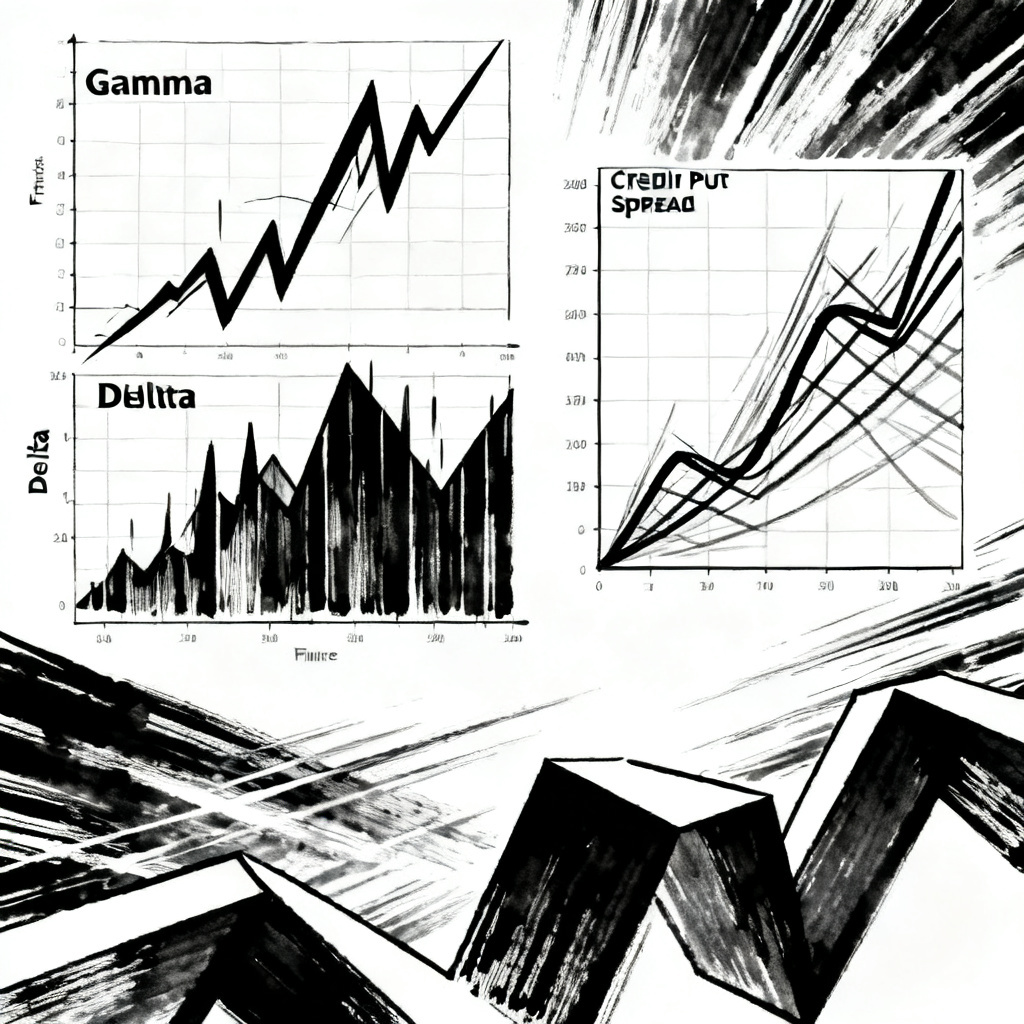
Gamma's Grip: The Silent Risk in Your Credit Put Spread
For traders employing credit put spreads, the primary focus often rests on two familiar Greeks: theta for time decay and delta for directional exposure. You sell a put, buy a further out-of-the-money put for protection, and collect a premium. The goal is for the stock to stay above your short strike, allowing the spread to expire worthless. It's a strategy celebrated for its defined risk and positive theta. However, lurking beneath this seemingly controlled environment is another Greek—gamma—whose influence can turn a calm trade into a trap during volatile markets. Understanding gamma's grip is not just academic; it's essential for managing the real, accelerating risks in your options portfolio.
Demystifying the Greek: What Exactly Is Gamma?
Gamma is the rate of change of an option's delta. If delta measures how much an option's price moves for a $1 move in the underlying stock, then gamma measures how much that delta itself changes. Think of delta as speed and gamma as acceleration.
- High Gamma: The option's
deltais highly sensitive to stock moves. A small move in the stock causes a large change in the option's directional exposure. - Low Gamma: The option's
deltais relatively stable, changing slowly even with stock movement.
Gamma is highest for at-the-money (ATM) options and increases as expiration approaches. This is the critical nexus where danger for credit spreads can explode.
The Gamma Trap in Credit Put Spreads: A Practical Example
Let's illustrate gamma's grip with a concrete example. Assume stock XYZ is trading at $105. You are bearish to neutral and sell a 30-day-to-expiration credit put spread.
- Trade: Sell the $100 Put / Buy the $95 Put for a net credit of $1.50.
- Initial Metrics (per share): The short $100 put has a
deltaof -0.30. The long $95 put has adeltaof +0.15. The net delta of the spread is therefore -0.15 (-0.30 + 0.15). This means for a $1 drop in XYZ, you'd expect the spread to lose about $0.15 in value—a manageable, linear risk.
Now, let fast-moving negative news hit. Over two days, XYZ plummets to $101, hovering just above your short strike. With only a few days to expiration, gamma is now in the driver's seat.
- New Metrics at $101: The short $100 put is now nearly ATM. Its
deltamight rocket to -0.85. The long $95 put, while still OTM, sees itsdeltaincrease to perhaps +0.45. - New Net Delta: -0.85 + 0.45 = -0.40.
Your position's sensitivity to the underlying stock has nearly tripled. The next $1 drop to $100 is no longer a $0.15 loss; it's now a $0.40 loss. The risk is accelerating non-linearly due to gamma. If the stock touches $100, the short put becomes ATM with a delta approaching -1.0, and the spread's value will rapidly converge toward its maximum loss of $3.50 ($5 wide - $1.50 credit). Gamma's grip has trapped the trade, transforming a gradual slide into a swift, painful drawdown.
Gamma vs. Theta: The Volatility Countdown
This scenario sets up a brutal tug-of-war between gamma and your friend, theta. In a credit spread, you are net short options, which typically means you are short gamma. Being short gamma means you experience accelerating losses when the market moves against you (as in our example) and diminishing gains when it moves in your favor. The benefit you collect for taking this risk is positive theta—the daily time decay.
When the underlying is stable and time passes, theta is king. Your spread loses value daily, and you profit. However, when a large directional move occurs, especially near expiration, gamma overpowers theta. The losses from the adverse delta change in a single day can wipe out a week's or month's worth of collected time decay. For the credit spread trader, gamma represents the "convexity risk"—the fact that losses accelerate faster than gains.
Managing Gamma Risk in Your Spreads
You cannot avoid gamma, but you can manage its grip through prudent trade construction and active risk management.
1. Give Yourself Time: Trade Further from Expiration
Gamma increases hyperbolically as expiration nears. The most effective way to reduce its immediate impact is to trade spreads with more time until expiration—45 to 60 days out, for example. While these spreads have lower absolute theta per day, the gamma is much lower, giving the underlying stock more room to fluctuate without causing wild delta swings. This provides you a larger window to manage or adjust the trade if it starts to move against you.
2. Widen Your Strike Selection
Placing your short strike further out-of-the-money (OTM) reduces the initial delta and gamma of that short option. While this also reduces the premium credit, it significantly lowers the probability of the stock hitting that strike and entering the high-gamma danger zone before expiration. A spread with a 20-delta short put is far less sensitive to gamma spikes than one with a 30- or 40-delta short put.
3. Active Delta Management and Hedging
Monitor the net delta of your spread portfolio. If a sharp move causes your net delta to become significantly negative (for put spreads), your position is telling you it's now acting like a much larger bearish bet than you intended. You can manage this by:
- Rolling Down and Out: If challenged, buy back the threatened spread and sell another one further OTM and in a later expiration cycle. This takes in more credit, resets your Greeks, and gives the trade more time.
- Delta Hedging with Stock: As a last resort for larger portfolios, you could buy a small amount of the underlying stock to neutralize the adverse delta. This is advanced and introduces new risks but can temporarily stabilize the position's P&L during a volatile spike.
4. Respect Volatility (Vega's Role)
Don't evaluate gamma in a vacuum. Enter credit put spreads when implied volatility (IV) is relatively high. High IV means you collect more premium, which provides a larger buffer against adverse moves. It also often precedes a contraction in volatility (a vega benefit). More importantly, be wary of selling spreads right before an earnings announcement or major news event. These periods are characterized by potential for large directional gaps (gamma risk) and could instantly put your short strike in the money.
Conclusion: Respecting the Convexity
Credit put spreads are powerful tools for generating income in flat or bullish markets, but their risk is not static. Gamma's grip is the mechanism that morphs a slow bleed into a rapid hemorrhage when the trade goes wrong. By understanding that your position's directional risk (delta) can change speed dramatically—especially near expiration—you transition from a passive premium collector to an active risk manager. Trade with more time, choose strikes prudently, monitor your net delta, and always respect periods of high potential volatility. In doing so, you don't just avoid traps; you build a more resilient and professional trading discipline.