IV Rank vs. Percentile: The Essential Gauge for Credit Spread Entries
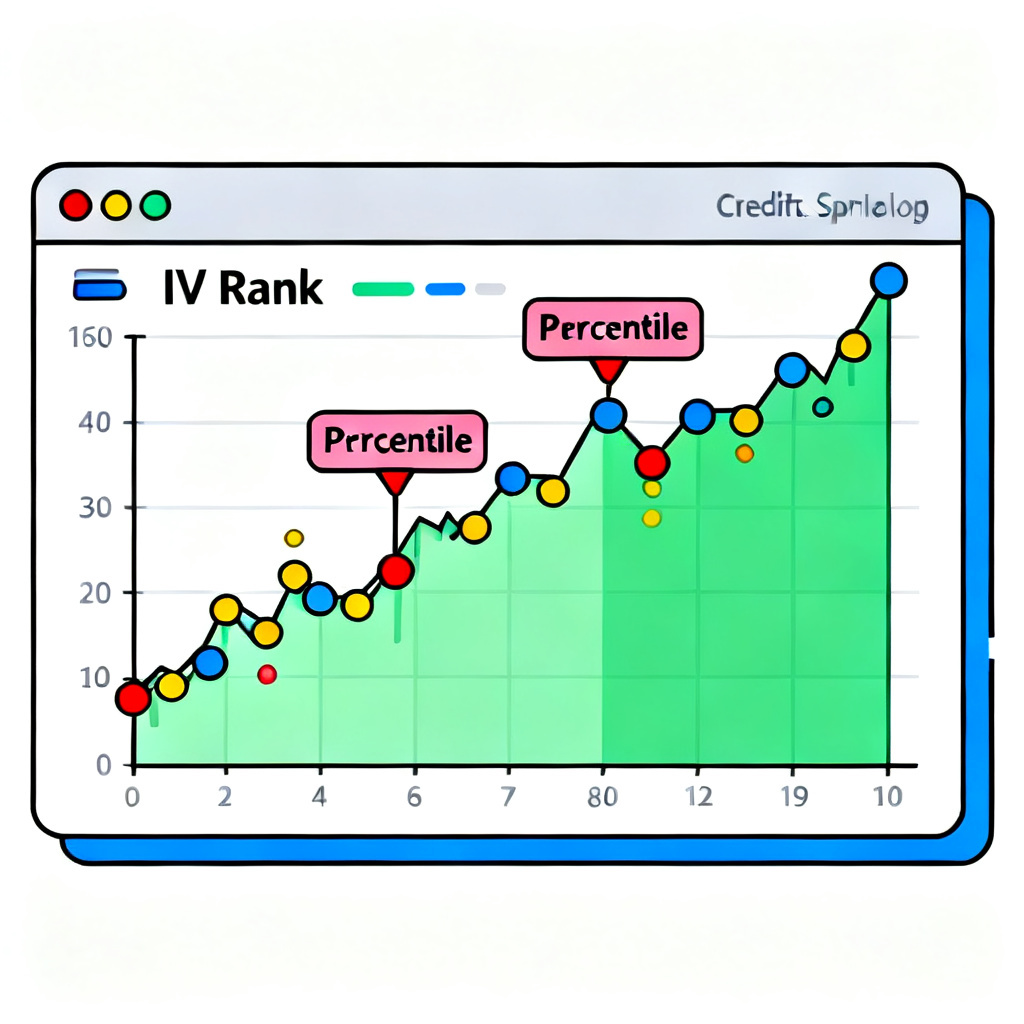
In the world of selling options, particularly credit spreads, timing is everything. Selling premium when it's cheap is a losing game. Your edge comes from selling when premiums are rich, juiced by market fear and uncertainty. To capture those inflated premiums, you need a reliable gauge. For years, traders have relied on "Implied Volatility" (IV) and its derived metrics—IV Rank and IV Percentile. While both are useful, one stands alone as the true north star for timing your credit spread entries. Let's break down why IV Rank is the undisputed champion for premium sellers.
The Foundation: Understanding Implied Volatility (IV)
Before we dive into the duel, let's establish the battleground. Implied Volatility (IV) is the market's forecast of a likely movement in a security's price. It's a forward-looking, theoretical value expressed as an annualized percentage. Think of it as the "temperature" of expected price swings. High IV signifies a hot, turbulent market expecting big moves (like during earnings or economic events). Low IV suggests a cool, calm market. For credit spread sellers, high IV is our friend—it inflates option premiums, giving us more credit upfront and widening our probability of profit.
Why High IV Matters for Credit Put Spreads
When you sell a credit put spread, you're collecting a premium in exchange for an obligation to buy stock at a certain price. That premium is your maximum reward. When IV is elevated, both the short put you sell and the long put you buy for protection are more expensive. However, because vega (an option's sensitivity to IV) is non-linear and impacts out-of-the-money options differently, the net credit you receive often gets a significant boost. Selling into high IV sets you up for a potential double win: a high initial credit and the prospect of IV crush—a rapid decline in IV after an event passes, which accelerates the decay of your short option's value.
The Contenders: IV Rank vs. IV Percentile
Knowing IV is high is one thing; knowing *how high relative to its own history* is the key. That's where our two metrics enter the ring.
What is IV Percentile?
IV Percentile (IV %ile) answers a specific question: "For what percentage of the last X trading days (typically one year) has the IV been *lower* than its current level?" If a stock's IV Percentile is 80, it means that over the past year, IV has been lower than it is now 80% of the time. It's a pure percentile ranking based on historical IV readings.
What is IV Rank?
IV Rank (IVR) answers a different, more practical question: "Where does current IV sit within its own 52-week high-low range?" It's calculated as: (Current IV - 52-Week IV Low) / (52-Week IV High - 52-Week IV Low). An IV Rank of 50 means IV is exactly halfway between its annual low and high. An IV Rank of 100 means IV is at its 52-week high.
The Showdown: Why IV Rank Wins for Credit Spread Entries
While both metrics provide context, IV Rank offers a more actionable and intuitive picture for premium sellers. Here's why.
1. It Measures "Juiciness" Directly
IV Rank tells you how "juicy" premiums are relative to the stock's own recent history. A rank of 70 or 80 signals that you're getting paid near the top of its range. IV Percentile, in contrast, can be misleading. Consider a stock with a very stable, low IV history that suddenly spikes. Its IV Percentile might rocket to 95, making it look extremely high. But if that spike only brings it to a level most other stocks consider "average," the actual premium you collect might still be underwhelming. IV Rank cuts through this noise.
2. It Aligns Perfectly with Volatility Skew
Volatility skew refers to the fact that options at different strike prices have different implied volatilities. Often, out-of-the-money puts (the ones we sell in credit put spreads) carry higher IV due to demand for protection. When overall IV Rank is high, this skew is often accentuated. Selling a put spread capitalizes on both high absolute IV *and* the steepness of the skew, maximizing your credit. IV Rank gives you the best signal for when this environment exists.
3. Practical Example: Selling a Put Spread
Let's say you're looking at Ticker XYZ, trading at $100.
- Its 52-week IV range is 20% (low) to 80% (high).
- Current IV is 68%.
- IV Rank Calculation: (68 - 20) / (80 - 20) = 48 / 60 =
0.80 or 80% IV Rank. - IV Percentile might be 75 (IV has been lower 75% of the last year).
This high IV Rank signals a prime opportunity. You decide to sell a 30-day-to-expiration put spread: Sell the $95 put, Buy the $90 put. Thanks to the high IV environment, you receive a net credit of $1.50 ($150 per spread).
Fast forward one week: The anticipated news event passes without major drama. IV crushes from 68% down to 40%. Even though the stock price only moves down to $98, your short spread now trades at $0.60 due to the accelerated time decay fueled by IV crush. You can buy it back for a $0.90 profit per spread, locking in 60% of your max profit in just one week. The high IV Rank set the stage for this profitable exit.
4. Avoiding the "Always High" Trap
Some stocks or ETFs (like many ARK funds or meme stocks) have perpetually high IV Percentiles because their historical volatility is structurally elevated. A 90 IV Percentile might be their *normal*. IV Rank helps you see if current IV is actually exceptional for *that* asset. If a meme stock has an IV range of 100% to 300%, and current IV is 120%, its IV Rank is low (~10), warning you that despite a high percentile, premiums aren't particularly rich for *that stock*.
Implementing IV Rank in Your Trading Plan
Here’s a simple framework for using IV Rank to guide your credit put spread strategy:
Entry Signal:
Focus on underlying assets with an IV Rank above 50. Many seasoned sellers wait for ranks above 70 for truly premium-selling conditions. This filters for trades where you are being compensated handsomely for risk.
Scanner Setup:
Use your brokerage or trading platform to scan for stocks/ETFs with high IV Rank. Pair this with fundamental or technical criteria you trust (e.g., price above 200-day MA, strong balance sheet). Don't just sell high IV in a crashing stock.
Exit Strategy:
Plan to profit from IV crush and time decay. Often, after an earnings report or Fed announcement, IV will plummet. This is your cue to consider closing the spread for a quick, partial profit rather than holding to expiration.
The Bottom Line: Rank Over Percentile
For the credit spread trader focused on maximizing premium income and capitalizing on mean-reverting volatility, IV Rank is the superior tool. It provides a clear, normalized view of how inflated premiums are relative to the specific asset's own personality. While IV Percentile has its uses in statistical studies, IV Rank delivers practical, actionable intelligence for your trade entries.
Make IV Rank your primary filter. Seek out those opportunities where the gauge reads "high," sell your defined-risk spreads, and let IV crush and time decay work in your favor. By understanding and applying this key distinction, you move from guessing to measuring, and from hoping for profit to engineering it.