Put Spread vs. Ratio Spread: When to Amplify or Define Your Risk
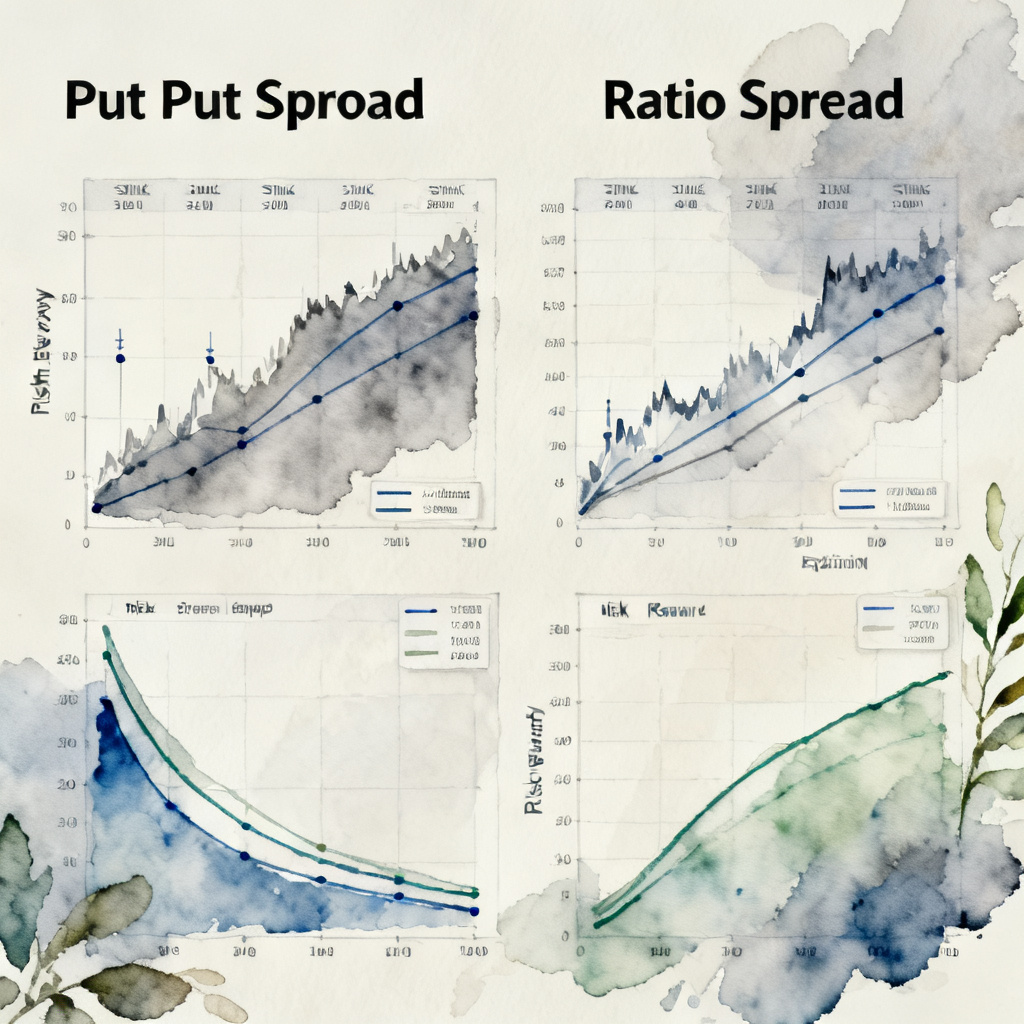
Navigating the Bearish-to-Neutral Spectrum: A Trader's Choice
In the world of options trading, selling puts is a classic approach for generating income from a neutral to bullish outlook. But when you want to move beyond a simple short put, two powerful strategies emerge: the put credit spread and the put ratio spread. Both involve selling puts, but their risk profiles and profit objectives are fundamentally different. Choosing between them isn't about which is "better," but about which tool is right for your specific market forecast and risk tolerance. This post will dissect the put spread versus the ratio spread, clarifying when you should define your risk and when you might choose to amplify it for greater reward.
Foundation Review: The Short Put
Before we compare the advanced strategies, let's recall the baseline. Selling a cash-secured put involves writing an out-of-the-money (OTM) put option, collecting a premium upfront, and obligating yourself to buy the stock at the strike price if it falls below it by expiration. The maximum profit is the premium received, while the potential loss can be substantial if the underlying asset plummets. It's a great strategy, but its undefined risk gives many traders pause. This is where our two comparison strategies come into play, each addressing this risk in a different way.
The Defined-Risk Workhorse: The Put Credit Spread
A put credit spread, also known as a bull put spread, is designed to take the undefined risk of a short put and put a hard floor under it. It's constructed by selling one OTM put (the short leg) and simultaneously buying a further OTM put (the long leg) in the same expiration cycle. The long put acts as an insurance policy, capping your maximum loss.
How It Works & The Payoff Profile
You receive a net credit when you open the position (the premium from the short put minus the cost of the long put). Your maximum profit is limited to that initial net credit. Your maximum loss is limited to the difference between the strike prices, minus the net credit received. The spread reaches max profit if the underlying price stays above the short put strike at expiration. Losses occur if the price falls below the long put strike.
Example: Stock XYZ is trading at $102. You are bullish-to-neutral.
- Sell the 95-strike put for
$2.00($200 premium). - Buy the 90-strike put for
$0.80($80 cost).
Net Credit: $2.00 - $0.80 = $1.20 ($120 per spread).
Max Profit: $120 (the net credit).
Max Loss: ($95 - $90) - $1.20 = $3.80 ($380 per spread).
Breakeven: $95 - $1.20 = $93.80.
When to Use a Put Credit Spread
Choose this strategy when you want to:
- Define and Limit Your Risk: This is the primary reason. You know your worst-case scenario before you enter the trade.
- Trade in a Lower-Capital Environment: Since risk is capped, margin requirements are significantly lower than for a cash-secured put.
- Express a Moderately Bullish or Range-Bound View: You profit if the stock stays flat or rises, with a small cushion (the short strike).
- Trade Higher-Priced Underlyings with Less Capital: It allows you to gain exposure to stocks like AMZN or GOOGL without tying up tens of thousands of dollars.
The Amplified-Credit Play: The Put Ratio Spread
A put ratio spread is a more nuanced, non-directional strategy that seeks to profit from time decay (theta) within a specific price range. It involves selling more puts than you buy. The most common is a 1x2 ratio: buying one OTM put and selling two even further OTM puts. This structure creates a zone of maximum profit if the stock expires between the two short strikes.
How It Works & The Payoff Profile
This trade is typically opened for a net credit, often a larger credit than a standard put spread on the same strikes. However, it comes with a critical trade-off: risk becomes undefined beyond a certain point. The long put protects you on one side, but since you are short an extra, naked put, losses can accelerate rapidly if the stock falls sharply below the lower short strike.
Example: Stock XYZ is trading at $102. You believe it will stay above $90, but see strong support.
- Buy one 95-strike put for
$2.00($200 cost). - Sell two 90-strike puts for
$0.80each ($160 total premium).
($0.80 * 2) - $2.00 = -$0.40? Wait, that's a debit. Let's adjust strikes.Let's say: Buy one 97.5-strike put for
$3.00. Sell two 92.5-strike puts for $1.40 each.Net Credit:
($1.40 * 2) - $3.00 = -$0.20? Still a small debit. A true "credit" ratio spread often requires the short puts to be closer to the money. The key is the ratio creates a wide profit zone.
Max Profit Zone: Achieved if the stock expires at or between the two short put strikes (92.5 in this adjusted example). Profit here is substantial.
Risk: Below the lower short strike (92.5), losses increase as the stock falls, as you are short an uncovered put.
When to Use a Put Ratio Spread
Choose this strategy when you want to:
- Amplify Your Premium Credit: You collect more upfront income compared to a vanilla spread.
- Profit from a Non-Move or a Gentle Decline: You have a strong conviction that the stock will not crash, but might drift lower to a specific support level.
- Trade High Probability, Defined-Range Scenarios: You identify a clear technical support zone where you believe the stock will be pinned.
- Accept Defined Risk on One Side, Amplified Risk on the Other: You are consciously trading a larger, undefined risk of a crash for a higher credit and a wider profit zone. This requires careful position sizing.
Head-to-Head Comparison: Key Decision Factors
| Factor | Put Credit Spread | Put Ratio Spread (1x2) |
|---|---|---|
| Primary Goal | Define risk, collect premium. | Collect larger premium, profit from a range. |
| Risk Profile | Defined & Limited. You know your max loss. | Partially Defined. Risk is limited between strikes but undefined to the downside. |
| Directional Bias | Moderately bullish. | Neutral to slightly bearish (favors a decline to the short strikes). |
| Capital Requirement | Lower (defined risk). | Higher (due to the naked short put risk). |
| Ideal Market View | "Stock will stay flat or go up." | "Stock will stay in this specific range or drift gently lower to this support." |
| Maximum Profit | Limited to net credit. | Potentially higher, realized in a price range. |
| Complexity | Lower. Easier to manage. | Higher. Requires active management if breached. |
Practical Application: Choosing Your Weapon
Let's translate this into a real trading decision.
Situation A: Earnings season is over, implied volatility (IV) is elevated but dropping, and you have a bullish outlook on QQQ, but don't want unexpected geopolitical news to blow up your account. You expect a slow grind higher.
Tool of Choice: Put Credit Spread. It defines your risk, benefits from falling IV (vega), and profits from your bullish view and time decay (theta). The defined risk lets you sleep at night.
Situation B: SPY has just bounced hard off a well-established support level at $440. It's now at $450. IV is moderate. You think it's highly unlikely SPY will crash below $440 again this month, but it might churn between $445 and $455.
Tool of Choice: Put Ratio Spread. You could structure a 1x2 with a long put at $445 and short puts at $440. You collect a juicy credit for expressing your high-conviction view that $440 will hold. Your max profit is realized if SPY lands between $440-$445 at expiration. You accept the undefined, low-probability risk of a crash below $440.
Final Thoughts: Discipline Over Dogma
The put credit spread is a foundational, defensive tool for the premium collector—it's about risk management first and profit second. The put ratio spread is an offensive, capital-efficient tool for the trader with a strong, range-based conviction—it's about amplifying credit for a calculated risk.
Your choice should never be random. Ask yourself: Is my forecast strong enough to justify undefined risk? How much capital am I risking on this single view? Does the market's volatility regime support this trade? By understanding the core mechanics of the put spread versus the ratio spread, you equip yourself to deliberately choose between defining your risk and amplifying your potential reward, aligning your strategy precisely with your market outlook and risk tolerance.