SpaceX Earnings: Lock-Up Looms as Stock Seeks a Floor
Earnings Day Isn't Just About the Numbers
The countdown clock for SPCX just got a lot louder. On Monday, Elon Musk's space venture announced August 4th as the date for its maiden earnings report. For most newly public companies, that's a straightforward milestone. For SpaceX, it's a trap door.
The report date is inextricably linked to the company's unique, staggered share lock-up expiration. This isn't your standard 180-day quiet period. SpaceX's structure allows insiders—early investors, employees, and yes, likely Musk himself—to begin selling portions of their stock much sooner. The first earnings report is the trigger.
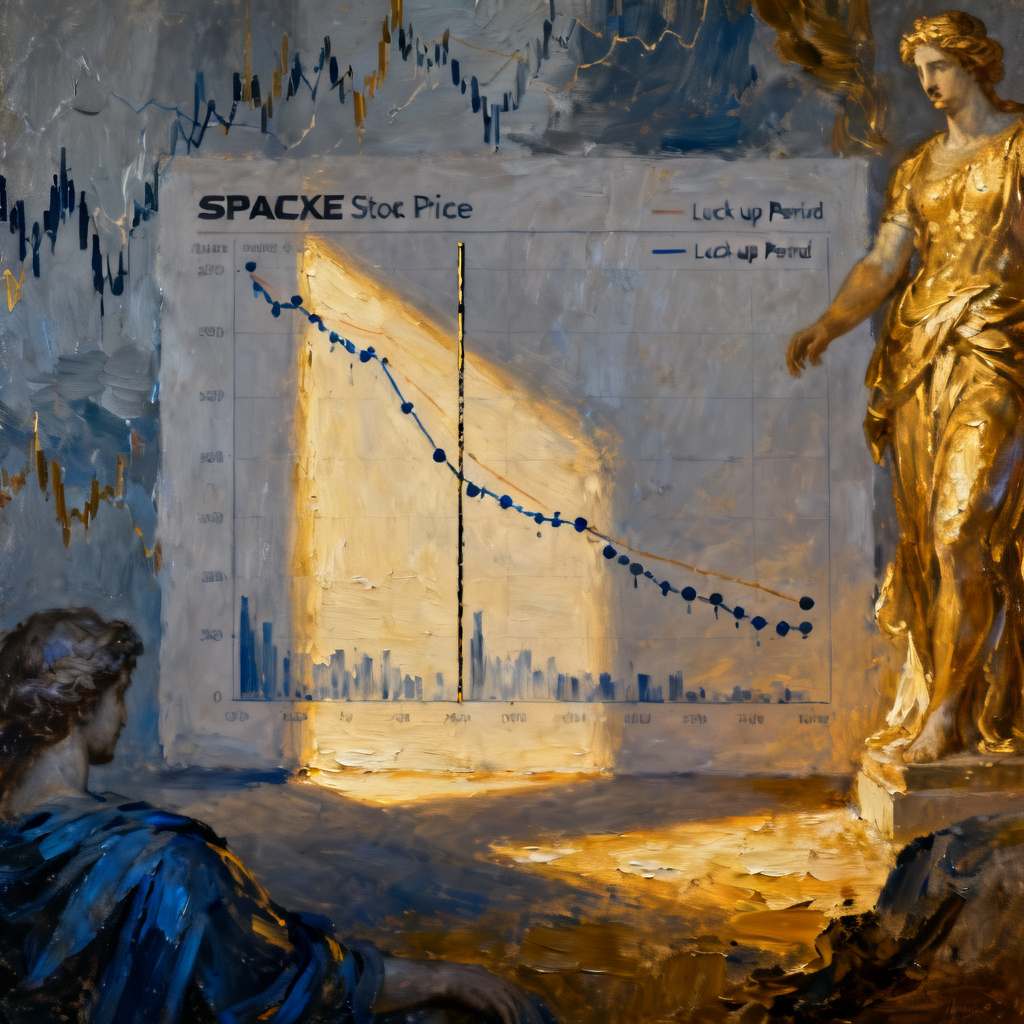
Here's the mechanic that should be on every trader's screen: on the second full trading day after earnings (that's August 6th), holders become eligible to sell up to 20% of their locked-up shares. That's a potential tidal wave of up to 911.5 million shares hitting the market. For context, only a fraction of the company's total shares are currently available for trading, which has amplified both the post-IPO rally and the subsequent crash.
The Lock-Up Liquidity Test
Why does this matter now? Because the stock is already on its back foot. As of Monday's close, SPCX had shed nearly half its value from its intraday high of $225.64 hit just days after its June IPO. It's a classic post-hype comedown, but the looming supply shock threatens to turn a correction into something uglier.
There's a potential pressure valve. An additional 10% of locked shares could be freed up if the stock closes at least 30% above its $135 IPO price for five out of the ten trading days leading into the earnings report. Given the current price hovers around $120, that trigger looks like a distant moon shot right now. The market is pricing in the dilution, not a bonus.
The smart money is already positioning for turbulence. Short interest has ballooned to cover about a third of the company's available public float—a massive bearish bet, especially for a stock with such a limited tradable share count. These shorts are banking on the lock-up expiration creating overwhelming selling pressure that pushes prices lower. Musk, never one to ignore his critics, took to X on Monday with a characteristically bold retort: "The survival probability of firms who maintain a significant short position in SpaceX over time is very low." A warning shot, or bluster from a CEO watching his net worth—once above $1 trillion—tumble to around $786 billion?
Beyond the Lock-Up: The Real Flight Path
While the lock-up drama dominates the tape, the long-term trajectory of SPCX hinges on two concrete, and recently shaky, pillars: execution and the Starship program.
The past week has seen two scrubbed launches—a Falcon 9 mission carrying Starlink satellites and, more critically, a halt of the massive Starship test flight due to an engine ignition failure. "Some of the engines didn't start, triggering an automatic launch abort," Musk posted. The company is now modifying the propulsion system, aiming for another attempt Thursday.
This isn't just a technical hiccup; it's a direct hit to the core investment thesis. Investors plowed a record $85.7 billion into the SpaceX IPO largely on the promise of Starship. This rocket isn't a side project. It's the linchpin for scaling the lucrative Starlink satellite internet business and the vehicle tasked with fulfilling SpaceX's multi-billion dollar obligations to NASA's Artemis moon program. Without reliable, rapid Starship progress, the financial model starts to crack.
The Earth-Bound Growth Engine: SpaceXAI
While eyes are on the stars, the more immediate revenue stream may be coming from data centers on Earth. The market is still digesting SpaceX's acquisition of Musk's xAI (now rebranded SpaceXAI) in February, a move that handed the company sprawling data centers and a power plant in Greater Memphis.
This isn't speculative. Google, Anthropic, and Reflection have already signed on to rent excess compute capacity. The company is also reportedly in talks with the Pentagon. This transforms SpaceX from a pure-play aerospace contractor into a hybrid "space and compute" infrastructure giant. For investors, it provides a potential near-term cash flow engine to help fund the capital-intensive Mars ambitions.
The Musk Portfolio Effect
You can't trade SpaceX in a vacuum. It exists within the gravitational pull of the Musk ecosystem. Tesla TSLA, Musk's first public company, reports earnings Wednesday. Institutional investors are already asking how the two giants will collaborate, specifically on the planned "Terafab" chip factory in Texas, where Tesla would lead R&D and SpaceX would handle production.
The whispers of a full Tesla-SpaceX merger are more than fan theory. SpaceX COO Gwynne Shotwell has publicly stated that combining the companies "would make Musk's life easier." For market participants, that's a tantalizing long-term possibility that could unlock synergies but also introduce massive complexity. Every stumble or triumph at Tesla now reverberates through sentiment for SPCX, and vice-versa.
What's the Trade?
So, where does this leave us? The immediate future is a technical and psychological battle around the $120 level. The earnings report itself will be scrutinized, but the real event is August 6th. Will insiders hold, believing in the multi-decade vision, or will they take profits after a brutal drawdown? The staggered lock-up was designed to prevent a cliff-like sell-off, but it doesn't eliminate the overhang.
The bulls need a clean Starship launch and clear evidence that SpaceXAI is ramping up revenue. They're betting that the current price already reflects the lock-up dilution and that long-term execution will win out.
The bears are leaning on the sheer weight of potential share supply, recent operational stumbles, and the hypothesis that the IPO hype far outpaced near-term reality. They see a stock that ran too far, too fast, and now faces its first true liquidity test.
One early investor called this drawdown "typical of IPOs." That may be true. But typical IPOs don't have a trillion-dollar founder, a rocket that holds the keys to national space ambitions, and a fanbase of retail traders ready to "buy the dip." Buckle up. The real voyage for SPCX is just beginning.