Theta Decay's Hidden Slowdown: The Mid-Contract Profit Trap
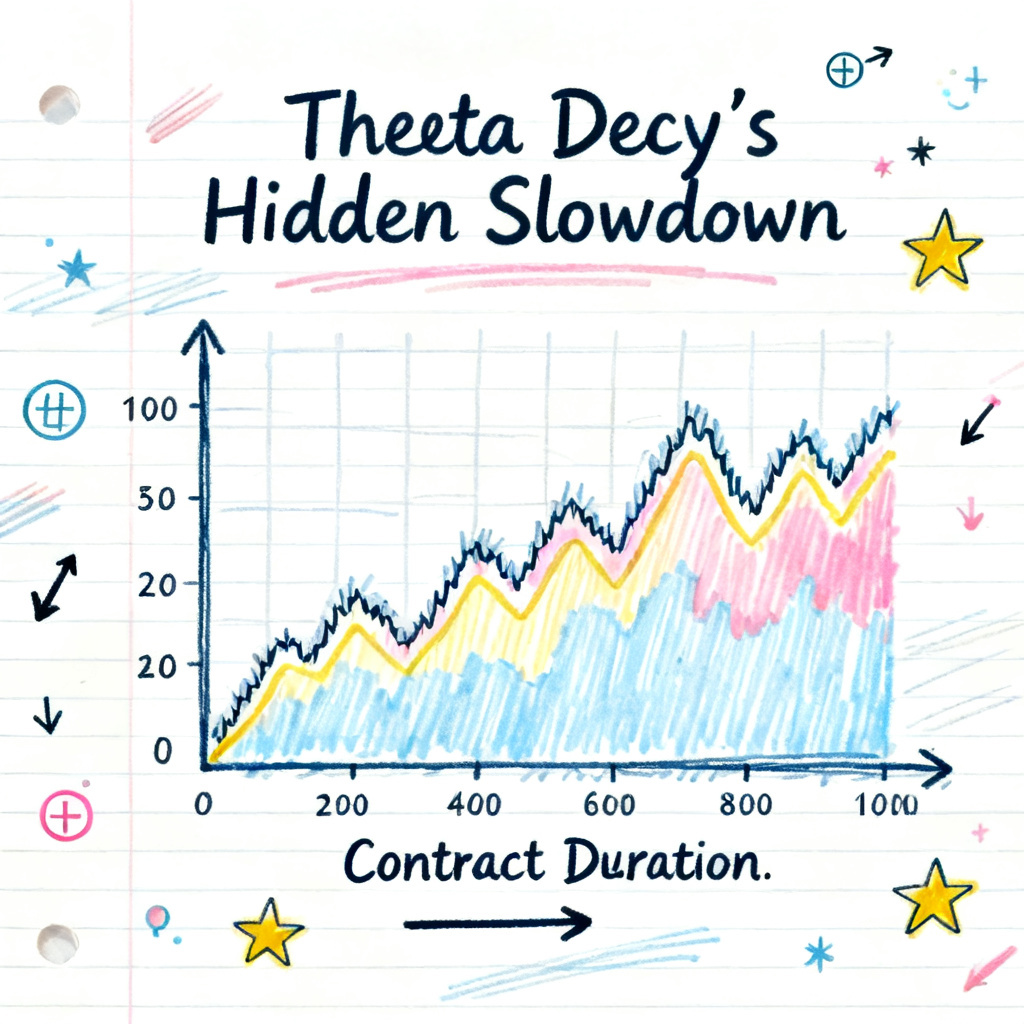
The allure of a credit put spread is undeniable. You collect premium upfront, you have a clear, defined risk, and you get to harness the power of time decay—Theta. Every day that passes without the underlying stock moving against you, your position theoretically inches closer to maximum profit. It feels like a slow, steady drip of gains. But then, around the halfway point of your contract's life, you check your position and… nothing. The profit hasn't budged much. The drip has slowed to a trickle. What happened? You've just encountered Theta's Time Decay Trap.
The Theta Promise vs. The Theta Reality
When you sell a credit put spread, you are fundamentally selling time. You believe the stock will stay above your short put's strike price, allowing the options you sold to expire worthless. The rate at which those sold options lose their time value is measured by Theta. New traders often picture Theta as a constant: -0.05 per day means you gain $5 daily per contract. If this were true, your profit graph would be a straight, diagonal line to max profit.
But the reality is starkly different. Theta is not a constant; it's an acceleration curve. The time value of an option does not evaporate at a steady rate. It decays slowly at first, then accelerates rapidly in the final weeks, and especially in the final days, before expiration. This non-linear decay is the core of the trap. Your profits don't accumulate evenly; they plateau in the middle and surge at the end, a fact your brokerage's profit/loss graph will clearly show.
Why Theta Decay Slows Down Mid-Contract
To understand the mid-contract slowdown, we need to look at Theta's relationship with another Greek: Gamma.
Gamma's Role in Theta's Curve
Gamma measures the rate of change of Delta. In simpler terms, it's the acceleration of your position's sensitivity to the stock price. Gamma is highest for at-the-money options and increases dramatically as expiration approaches.
Here’s the crucial interaction: Theta and Gamma are intrinsically linked. An option with high Gamma (high sensitivity to price movement changes) also tends to have high Theta (rapid time decay). In the first few weeks of a 45-day contract, your short put spread, especially if it's out-of-the-money, has relatively low Gamma. Because its sensitivity to the stock price isn't changing rapidly, the "insurance premium" of time value also isn't decaying rapidly. The market is pricing in more time for something to go wrong.
The Mid-Contract "No-Man's Land"
Imagine you sold a 30-day credit put spread on Stock XYZ at a $95/$90 strike when the stock was at $100. For the first 15 days, the stock drifts between $99 and $102. You're safe, but your profit has only increased by about 30-40% of the total credit received. Why? Because with 15 days left, there's still significant time for a downturn. The Theta decay is present but modest. You're in the shallow part of the time decay curve.
The Vega Factor: When Volatility Muddies the Waters
Another Greek can mask or exacerbate the Theta trap: Vega. Vega measures sensitivity to changes in implied volatility (IV). When you sell options, you are short volatility; you want IV to decrease or stay flat.
Mid-contract, even if time is passing (positive Theta), a rise in overall market volatility or volatility in your specific stock can increase the option's premium. This Vega effect can offset your Theta gains, leading to a frustrating period of zero net progress. Your position might show a gain from Theta but an equal loss from rising Vega, resulting in that flatlining P&L. This is especially common during earnings seasons or market-wide uncertainty.
A Practical Example: Watching the Greeks in Action
Let's track a real credit put spread to see the trap unfold.
Trade: Sell to open SPY $500 Put / Buy to open SPY $495 Put. Expiration in 45 days. Credit received: $1.50 ($150 per spread).
- Day 1 (45 DTE): SPY at $510. Theta for the spread is
+0.02. Vega is-0.08. Daily theoretical gain from time: $2. - Day 15 (30 DTE): SPY at $508. Theta has increased to
+0.03. Vega is-0.05. Daily gain: $3. Your total profit to date might be ~$60. Progress feels slow. - Day 30 (15 DTE): SPY at $505. Theta now jumps to
+0.08. Vega drops to-0.02. Daily gain: $8. The acceleration is beginning. Your total profit might be ~$90. The middle period added less than the first. - Day 44 (1 DTE): SPY at $502. Theta explodes to
+0.50. Vega is negligible. Your position earns most of its remaining time value in this final phase.
Notice the plateau between Day 15 and Day 30? The profit increase was minimal compared to the final two weeks. That's the trap.
Navigating the Theta Trap: Strategic Adjustments
Knowing about the trap allows you to manage it strategically instead of being frustrated by it.
1. Trade Shorter Durations
If the mid-contract slowdown doesn't fit your capital or patience, shift to spreads with 30-45 days to expiration and plan to manage or close them at 14-21 DTE. This allows you to operate in the steeper part of the Theta decay curve more frequently.
2. Actively Manage at the Inflection Point
Use the mid-contract period (around 20-30 DTE) as a decision point. If your profit is stagnant but the position is still safe, you can often "roll" the spread: close the current one and open a new one in a further expiration cycle, collecting more premium and resetting the Theta decay curve.
3. Factor in Vega from the Start
Open credit spreads when IV is relatively high (e.g., after a pullback). This gives you a "Vega cushion." You benefit not only from time decay (Theta) but also from the potential for volatility to contract (positive Vega effect), which can help propel profits through the mid-contract lull.
4. Trust the Process (and the Graph)
Sometimes, the best action is inaction. Understanding that non-linear Theta decay is a fundamental feature of options—not a flaw in your trade—is key. Let the mechanics work. The final week will often deliver the bulk of the profit you anticipated from the slow-and-steady model.
The Bottom Line for the Spread Trader
Theta is your ally in credit spread trading, but it's not a dutiful soldier marching in a straight line. It's a sprinter who conserves energy for a powerful finish. The mid-contract profit slowdown is not a sign of a broken trade; it's the predictable effect of low Gamma and the structure of time premium. By incorporating an understanding of Theta's curve and its interplay with Gamma and Vega, you can set realistic expectations, choose better entry and exit points, and ultimately harness the true, non-linear power of time decay in your favor. Stop watching the daily drip and start planning for the final cascade.